How to Calculate How Much Concrete You Need
Planning a concrete project? Whether you’re pouring a driveway, patio, or foundation, knowing how to calculate how much concrete you need saves you money, time, and unnecessary trips to the supplier. Ordering too little stalls your project halfway through, while ordering too much wastes cash and creates disposal headaches. Fortunately, calculating concrete volume isn’t complicated once you understand the basic formula.
Why Accurate Concrete Calculation Matters
First and foremost, precise measurements prevent costly mistakes. Because ready-mix concrete sets quickly, you can’t simply “add more” halfway through a pour. Consequently, contractors and DIYers alike rely on accurate calculations before the truck even arrives. Additionally, getting the numbers right helps you budget effectively, since concrete pricing is typically based on cubic yards.
The Basic Concrete Calculation Formula
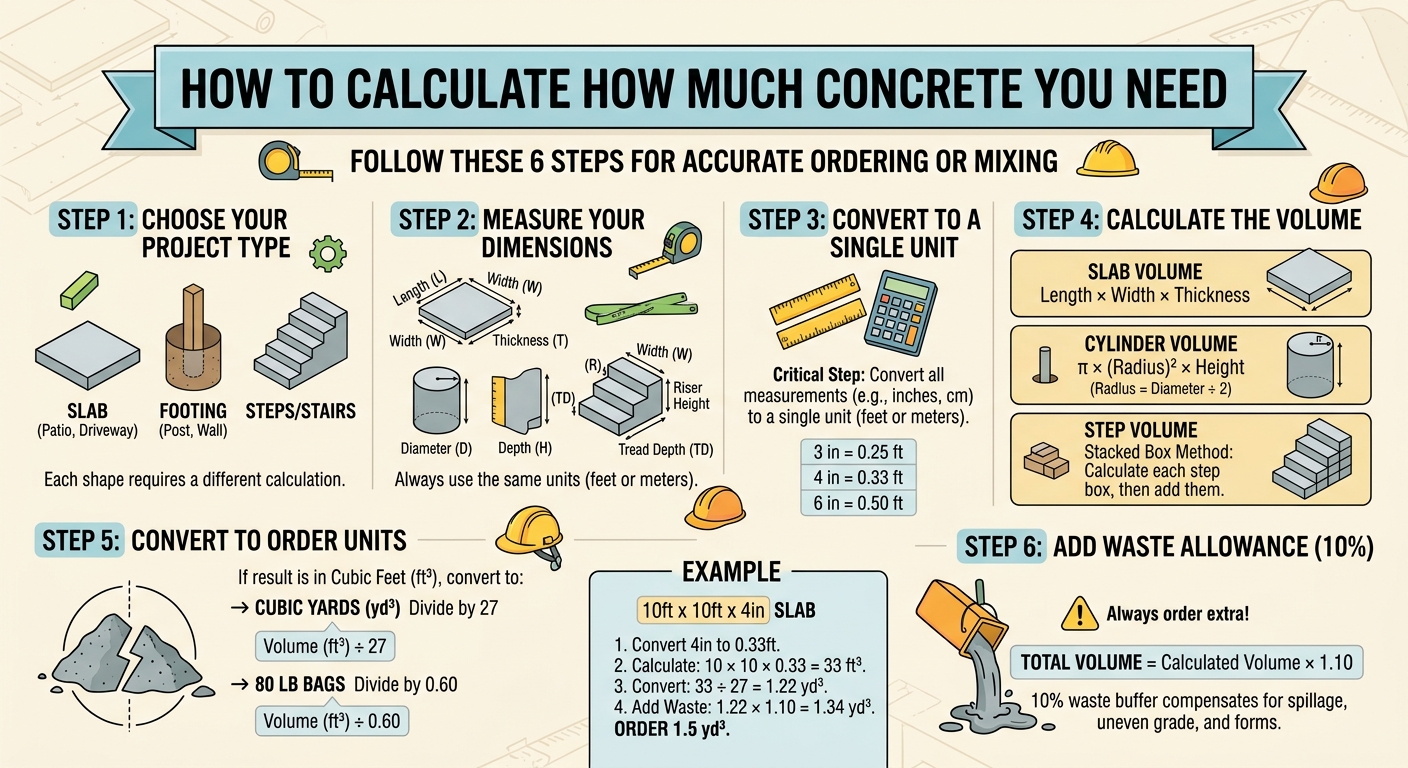
To calculate concrete volume, you’ll need three measurements: length, width, and depth (or thickness). Here’s the standard formula:
Length (ft) × Width (ft) × Depth (ft) ÷ 27 = Cubic Yards of Concrete
The division by 27 converts cubic feet into cubic yards, since concrete is sold by the cubic yard in most regions. For example, imagine you’re pouring a slab that’s 10 feet long, 10 feet wide, and 4 inches deep. First, convert the depth into feet (4 inches ÷ 12 = 0.33 feet). Then multiply: 10 × 10 × 0.33 = 33 cubic feet. Finally, divide by 27, giving you approximately 1.22 cubic yards.
Step-by-Step Process
- Measure the area accurately. Use a tape measure for length and width, and double-check corners for irregular shapes.
- Determine the depth. Standard slabs are usually 4 inches thick, while driveways often require 5–6 inches for durability.
- Convert all measurements to feet. This ensures your formula produces the correct cubic footage.
- Apply the formula. Multiply length by width by depth, then divide by 27.
- Add a buffer. Since spillage, uneven ground, and minor miscalculations are common, most professionals recommend adding 5–10% extra to your total.
For irregular or circular areas, the formula changes slightly. For circular slabs, use: Radius² × 3.14 × Depth ÷ 27. Meanwhile, for multiple sections, calculate each area separately, then add the totals together before ordering.
Tools That Simplify the Process
Nowadays, many suppliers offer free online concrete calculators, which instantly convert your measurements into cubic yards. These tools are especially useful for beginners, as they eliminate manual math errors. Nevertheless, understanding the underlying formula remains valuable, since it helps you verify the calculator’s output and catch mistakes before they become expensive problems.
Understanding Concrete Costs
Once you know your volume, the next logical step is budgeting. On average, ready-mix concrete costs between $110 and $165 per cubic yard, though prices vary based on location, mix strength, and delivery distance. Furthermore, additional costs may include:
- Labor charges, typically $2–$8 per square foot for professional installation
- Reinforcement materials, such as rebar or wire mesh
- Site preparation, including grading and formwork
- Finishing touches, like sealants or decorative stamping
Therefore, while the concrete itself is a major expense, it’s essential to account for these additional factors when creating your overall project budget.
Benefits of Accurate Concrete Calculation
Calculating your concrete needs correctly offers several advantages. To begin with, it prevents overordering, which reduces waste and unnecessary spending. Similarly, it avoids underordering, which can cause “cold joints”—weak seams that form when concrete is poured in separate batches instead of continuously. As a result, your finished structure gains better structural integrity and a more uniform appearance.
Moreover, accurate calculations streamline scheduling. Since ready-mix trucks charge for waiting time, ordering the correct amount ensures the pour goes smoothly without costly delays. In addition, precise planning helps you coordinate labor, tools, and curing time more effectively.
Pro Tips for a Smooth Concrete Project
- Always round up. Even a slightly larger buffer is better than running short mid-pour.
- Account for ground irregularities. Uneven subgrade can increase the actual volume needed.
- Order from a reputable supplier. This ensures consistent mix quality and reliable delivery times.
- Check weather conditions. Extreme heat or cold can affect curing time and workability, so plan accordingly.
- Consult a professional for large projects. While small patios are manageable DIY jobs, foundations and driveways often benefit from expert oversight.
Why Choose Us for Your Concrete Needs
Unlike generic suppliers, our team combines accurate volume calculations with premium, locally sourced materials to ensure every pour meets your exact specifications. We don’t just deliver concrete we help you plan the entire process, from measurement to finishing, so your project stays on time and within budget. Our transparent pricing and expert guidance set us apart, giving you confidence at every stage of construction.
Ready to start your project? Contact us today for a free concrete estimate, and let our specialists help you calculate the exact amount you need no guesswork required.
Frequently Asked Questions (FAQs)
Q: How much concrete do I need for a 10×10 slab?
For a standard 4-inch-thick slab, you’ll need approximately 1.22 cubic yards. However, always add a 5–10% buffer for waste and uneven surfaces.
Q: How thick should my concrete slab be?
Typically, patios and walkways require 4 inches, while driveways need 5–6 inches to handle vehicle weight.
Q: Can I calculate concrete for irregular shapes?
Yes. Simply break the area into smaller, measurable sections, calculate each separately, and then add the totals together.
Q: How many bags of concrete equal one cubic yard?
On average, it takes about 60 bags of 60-lb concrete mix, or 45 bags of 80-lb mix, to equal one cubic yard.
Q: What happens if I order too little concrete?
Running short mid-pour can create weak seams called cold joints, which compromise structural strength. Therefore, it’s always safer to overestimate slightly.
Final Thoughts
Ultimately, learning how to calculate how much concrete you need empowers you to plan smarter, spend wisely, and avoid mid-project setbacks. By following the simple length × width × depth ÷ 27 formula, adding a safety buffer, and accounting for related costs, you’ll be well-prepared for a successful pour. So, before your next concrete project, take the time to measure carefully and reach out to our team for expert guidance every step of the way.