10 Types of Construction Excavation Every Contractor Should Know
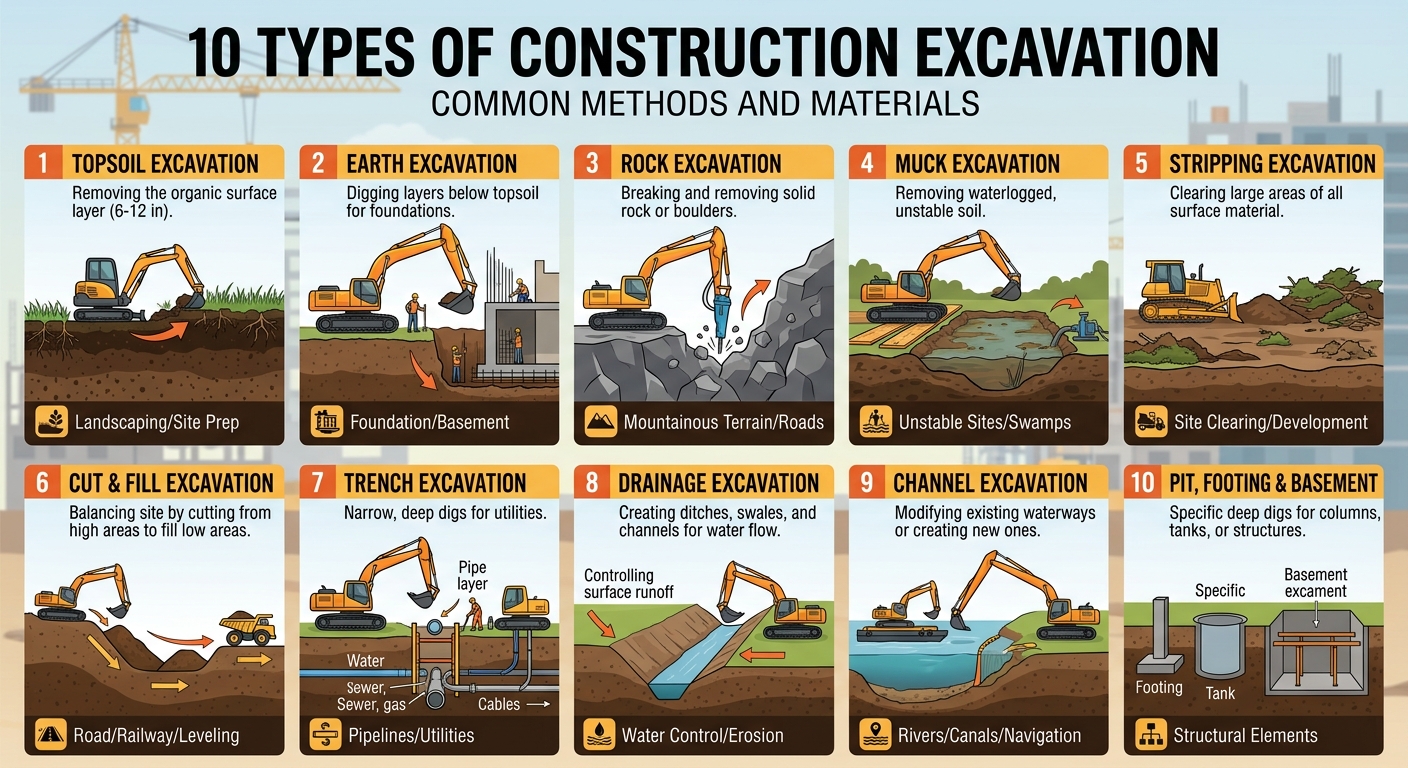
Excavation forms the foundation of every successful build. Before a single beam rises or a wall takes shape, contractors must dig, shape, and prepare the earth correctly. Understanding the different types of construction excavation helps contractors choose the right method, avoid costly delays, and deliver safer, more durable projects. In this guide, we break down ten essential excavation types, explain when to use each, and answer the questions contractors search for most.
Why Understanding Excavation Types Matters
Every project site presents unique soil conditions, load requirements, and structural goals. Consequently, contractors who understand excavation categories can match the right equipment and technique to the job, reducing rework and protecting their budget. Moreover, choosing the correct excavation method improves site safety, since improper digging often leads to collapses, flooding, or structural instability. Therefore, mastering these ten types isn’t optional knowledge it’s a core professional skill.
1. Topsoil Excavation
Topsoil excavation removes the uppermost layer of soil, typically rich in organic material and unsuitable for bearing structural loads. Contractors perform this step first, before any foundation work begins. Because topsoil often contains roots, vegetation, and loose debris, builders must clear it completely to reach stable ground beneath. Afterward, the removed topsoil frequently gets stored for later landscaping use, which reduces material costs.
2. Rough Excavation
Rough excavation follows topsoil removal and involves large-scale earth moving to establish the general shape of a site. During this phase, crews cut and grade land to match design elevations. Since precision isn’t the primary goal here, contractors rely on heavy machinery like bulldozers and excavators to move large soil volumes quickly. Later, finer excavation methods refine the exact dimensions.
3. Cut and Fill Excavation
Cut and fill excavation balances soil removal and soil addition across a site to achieve a level surface. In practice, excess earth from higher elevations gets relocated to fill lower areas, minimizing the need to import or export material. As a result, this method significantly reduces transportation costs and environmental impact. However, engineers must calculate volumes carefully, or the site may end up with instability issues.
4. Trench Excavation
Trench excavation creates narrow, deep channels used for installing utilities such as water lines, sewer pipes, electrical conduits, and drainage systems. Given the depth involved, trench work carries serious safety risks, including cave-ins. Consequently, OSHA regulations require shoring, shielding, or sloping for trenches deeper than five feet. Additionally, contractors must account for existing underground utilities before digging to prevent damage or service disruption.
5. Basement Excavation
Basement excavation involves digging deep, wide pits to accommodate below-grade living or storage spaces. Since basements bear significant structural weight, this excavation type demands precise depth control and strong soil stabilization. Furthermore, contractors must manage groundwater carefully, as water infiltration can compromise foundation integrity. In areas with high water tables, dewatering systems often become necessary before construction proceeds.
6. Dredging Excavation
Dredging excavation removes sediment, sand, or debris from underwater environments like rivers, lakes, harbors, and canals. This specialized technique supports projects such as waterway deepening, marina construction, and flood control. Because dredging occurs underwater, contractors rely on specialized equipment, including suction dredgers and clamshell excavators. Meanwhile, environmental regulations often govern dredging projects closely, since disturbing aquatic sediment can affect local ecosystems.
7. Muck Excavation
Muck excavation deals with wet, unstable soil mixtures typically a combination of water, clay, and organic matter that cannot support structural loads. Since muck lacks bearing capacity, contractors must remove it entirely and replace it with compactable fill material. Otherwise, structures built on muck risk severe settling or collapse. This type of excavation frequently appears in wetland or floodplain construction projects.
8. Earth Excavation
Earth excavation refers to the general removal of soil to reach a desired depth or grade, commonly used for building foundations, roadways, and landscaping projects. Unlike rock excavation, earth excavation deals with looser, more workable material. As such, standard excavators and backhoes typically handle this task efficiently. Nevertheless, contractors must still test soil composition beforehand to confirm it meets load-bearing requirements.
9. Rock Excavation
Rock excavation becomes necessary when a site’s subsurface contains solid rock formations that standard equipment cannot easily remove. In these cases, contractors often use blasting, hydraulic hammers, or rock-cutting machinery to break through dense material. Because this process demands specialized tools and safety protocols, rock excavation typically costs more and takes longer than soil-based digging. Still, it’s an unavoidable step in mountainous or rocky terrain projects.
10. Footing and Pile Excavation
Footing and pile excavation prepares the ground for foundation supports that transfer a structure’s weight to stable soil or bedrock. While footing excavation creates shallow trenches for spread foundations, pile excavation digs deep, narrow holes for driven or drilled piles in weaker soil conditions. Both methods require exact depth and alignment, since even minor errors can compromise a building’s structural integrity.
Choosing the Right Excavation Partner
No two job sites are identical, and therefore no single excavation method fits every project. That’s precisely why experienced contractors evaluate soil type, water table depth, load requirements, and site accessibility before selecting an approach. A trusted excavation partner brings the right equipment, certified operators, and site-specific expertise to every project stage ultimately saving time, reducing risk, and protecting your investment. If you’re planning an upcoming build, contact our excavation team today for a free site assessment and a detailed project quote.
Frequently Asked Questions (FAQs)
What is the most common type of construction excavation?
Earth excavation ranks among the most common types, since nearly every construction project requires some form of soil removal to reach proper grade or foundation depth.
How deep can trench excavation safely go without shoring?
Under OSHA guidelines, trenches deeper than five feet generally require protective systems such as shoring, shielding, or sloping to prevent collapse.
What’s the difference between cut and fill excavation and rough excavation?
Rough excavation shapes the general site layout, while cut and fill excavation specifically balances soil volumes between higher and lower areas to achieve a level, stable surface.
Why does muck excavation matter for construction safety?
Because muck cannot support structural loads, leaving it in place risks foundation settling, cracking, or collapse. Removing and replacing it with compactable fill ensures long-term stability.
When is rock excavation necessary?
Rock excavation becomes necessary whenever subsurface bedrock or dense rock formations block standard digging equipment, requiring blasting or specialized cutting tools instead.
How do contractors decide which excavation type to use?
Contractors typically assess soil composition, water table levels, project depth requirements, and site accessibility before selecting the appropriate excavation method for a given job.
Understanding these ten excavation types equips contractors to plan smarter, bid more accurately, and execute safer projects from the ground up. Whether you’re managing a small residential build or a large commercial development, matching the right excavation technique to your site conditions makes all the difference. Ready to get started? Reach out for a professional excavation consultation and build your project on solid ground.